The Comeback Pace: Rebuilding After Injury with Fife AC

Photo: DanTD, CC BY-SA 4.0, via Wikimedia Commons
There is a particular kind of optimism that arrives about ten days into an injury. The sore bit has stopped shouting. A short walk feels normal. Someone mentions a race in six weeks and, suddenly, the comeback plan has gone from cautious to ambitious. Most runners know this feeling. Most runners have also paid for it.
At Fife AC, the conversation around injury has become less about heroic returns and more about sensible ones. Coaches, physios and clubmates tend to say the same thing in different ways: the aim is not to get back to where you were as quickly as possible. It is to get back to running in a way that lasts.
The boom-bust trap
The boom-bust cycle is the classic comeback mistake. You rest until the pain settles, then return with the enthusiasm of someone who has been locked out of their favourite room. A few good runs follow. Then a niggle returns, or a different one appears, and you are back on the sofa wondering why your body will not cooperate.
The problem is rarely one bad run. It is usually the gap between what you feel ready for and what you are actually ready for. A calf that has tolerated walking and easy cycling may not be ready for a Tuesday night session. A knee that feels fine on flat pavements may object to a long descent from the Lomond Hills. The body is not being difficult; it is giving information.
Fife AC coaches often talk about setting a comeback pace rather than a comeback target. That might mean run-walk intervals on the coastal path between Leven and Kirkcaldy, or a short loop from Falkland that can be cut short without drama. The point is to make the first few weeks repeatable. If you can do the same easy session three times without a reaction, you are building something. If you cannot, you have learned something useful before it becomes a bigger problem.
Easy miles, good company
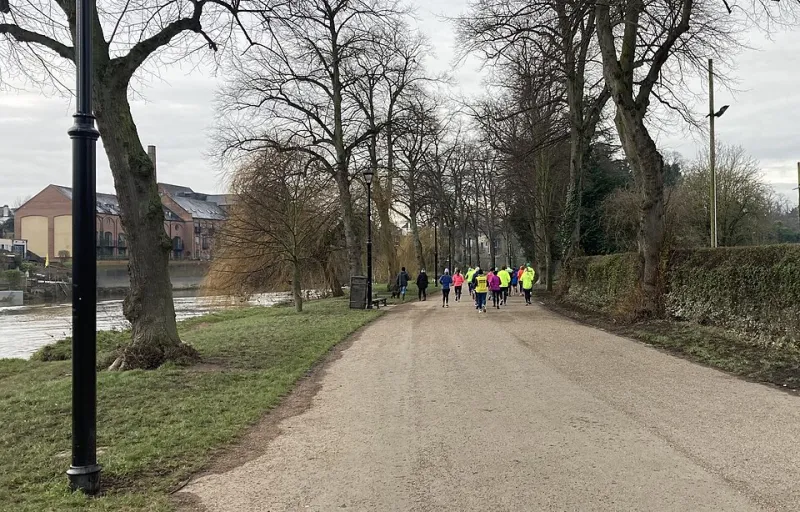
One of the quiet advantages of club running is that it makes easy running easier. When you are rebuilding, the temptation is to run alone so nobody sees you going slowly. In practice, the opposite often works better. A steady club run gives you company, a sensible route and a natural cap on effort. You are less likely to surge up a hill because someone else is chatting, and more likely to finish feeling like you could have done a little more.
That last feeling is a good guide. Comebacks are not the time to finish sessions empty. They are the time to finish them and think, yes, I could do that again. Fife AC’s regular runs offer plenty of chances to test that without turning it into a race. The flat cycle paths around Glenrothes, the quieter roads near Ceres, the broad paths around St Andrews — these are not just pleasant places to run. They are useful places to relearn pace.
It also helps to tell people what you are doing. A simple “I’m coming back from a calf strain, so I’ll be taking it easy” does more than you might think. It gives clubmates permission to run alongside you rather than disappear up the road, and it stops you from pretending you are further along than you are.
Cross-training without the guilt
For many runners, cross-training feels like a poor substitute. It is not. It is a way of keeping the engine running while the running-specific parts recover. Swimming, cycling, elliptical work, strength sessions and even brisk walking can all play a part, provided they are appropriate for the injury and cleared by a physio where needed.
The key is to treat cross-training as training, not as punishment. A steady bike session can maintain fitness without loading a sore shin. A short strength routine can address the hip or glute weakness that may have contributed to the problem in the first place. It can also give structure to a week that otherwise feels shapeless.
What cross-training should not do is become another boom-bust cycle. If you are injured and suddenly doing two hours of cycling a day because you cannot run, that is not a gentle return; it is a different kind of overload. Keep it moderate, keep it varied, and keep asking whether it is helping you feel better or simply helping you feel less guilty.
Borrowing belief from the club
Injury can chip away at confidence as much as fitness. A run that used to feel easy now feels effortful. A familiar route seems longer. You start to wonder whether you will ever feel fluent again.
This is where fellow runners matter. Not in a grand, motivational-speech way, but in the ordinary way that club life works. Someone remembers that they had the same problem two winters ago. Someone recommends a physio in Kirkcaldy. Someone else points out that you are still turning up, still doing the work, still part of the Tuesday group even if you are only doing the warm-up and a short loop.
Fife AC coaches can help with the bigger picture, too. They can adjust sessions, suggest alternatives and remind you that fitness is not lost in a fortnight. A physio can give you markers for progress. Clubmates can give you something less clinical: the sense that a comeback is normal, not a personal failure.
A local network, not a lonely rehab
The best injury comebacks are rarely solo projects. They are built from small pieces of local support. A coach who knows your running history. A physio who understands the demands of the club session you want to return to. A friend who agrees to run at your pace rather than theirs. A route that lets you turn back early without feeling like you have failed.
Fife is well suited to this kind of gradual rebuilding. There are short loops and long ones, flat paths and gentle climbs, town pavements and coastal trails. You can choose the terrain that suits the stage you are at. You can also choose the company that suits it.
The slow return is not the glamorous part of running. It does not make for dramatic race reports. But it is where a lot of good club running is built: patiently, locally, and with a bit of help from the people around you. The finish line is just a marker. The real aim is to get back to the point where running feels like something you do, not something you are waiting to do again.